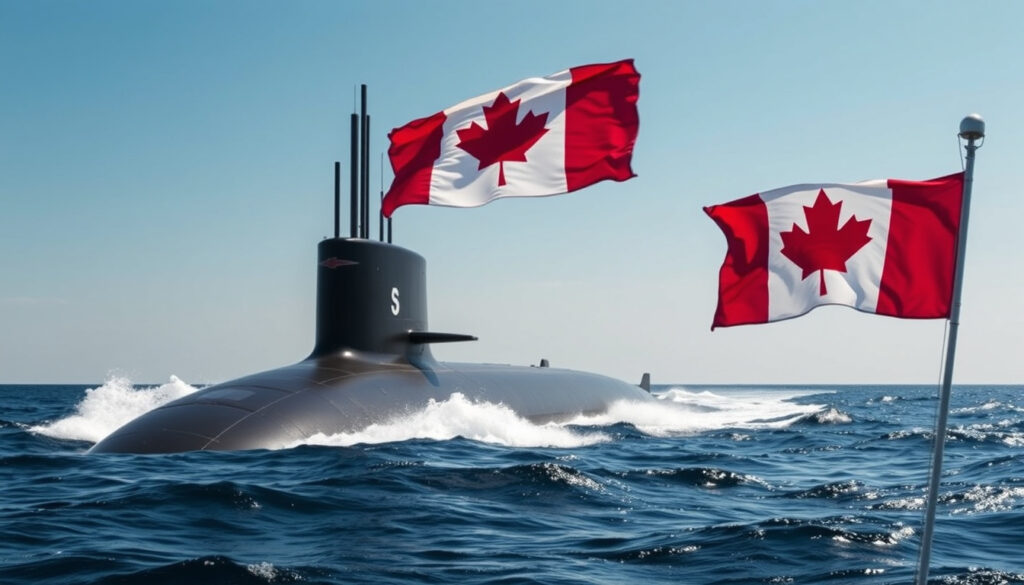
South Korea Submarine Offer to Canada: $20B KSS-III Bid
When a nation’s navy struggles to keep even a single submarine operational, the pressure to modernize becomes urgent and visible. South Korea’s Hanwha Ocean just sailed its KSS-III 14,000 kilometers across the Pacific to demonstrate exactly that capability — and it’s not a coincidence that the vessel docked in Canada in April 2026, as Ottawa weighs a C$20-24 billion submarine program that could reshape the Royal Canadian Navy for decades. The show of force puts the Indo-Pacific ally in direct competition with Germany’s Thyssenkrupp Marine Systems for what may become the largest naval procurement in Canadian peacetime history.
Procurement value: C$20-24B ·
Shortlisted bidders: Hanwha KSS-III vs. Thyssenkrupp Type 212CD ·
Canada’s operational subs: Struggles to keep one at sea ·
Potential first delivery: 2032
Quick snapshot
- Bids narrowed to South Korea KSS-III and Germany Type 212CD (Defence Industry Europe)
- KSS-III visited Canada by April 8, 2026 (USNI News)
- Up to 12 submarines planned under CPSP (Hanwha Ocean)
- Final contract decision date — reportedly spring or summer 2026 (Philippe Lagasse)
- Winner of the C$20-24 billion deal remains undecided (Philippe Lagasse)
- Exact delivery schedule beyond first submarine (Philippe Lagasse)
- Canadian Patrol Submarine Project onset: 2021 (USNI News)
- ASW drills scheduled May 23 to June 2, 2026 off Canada’s west coast (Army Recognition)
- Contract award reportedly possible 2026, formal deadline 2028 (USNI News)
- First KSS-III delivery projected for 2032 if contract signed 2026 (Hanwha Ocean)
- Up to four submarines by 2035 under Hanwha proposal (Hanwha Ocean)
- Decision expected spring or summer 2026 (Hanwha Ocean)
| Metric | Value |
|---|---|
| Program start | 2021 |
| Shortlisted bidders | Hanwha KSS-III, Thyssenkrupp Type 212CD |
| Potential submarines | Up to 12 |
| First arrival (if contracted) | 2032 |
| Recent event | KSS-III voyage to Canada completed April 8, 2026 |
Where did Canada get their submarines?
Canada’s current submarine fleet consists of four Victoria-class submarines, originally built for the Royal Navy in the 1990s and purchased by Canada between 1998 and 2000. These vessels — Victoria, Windsor, Chicoutimi, and Corner Brook — were acquired secondhand and have spent much of their service life docked for repairs rather than at sea. The Victoria-class fleet was never fully operational after integration issues, cost overruns, and mechanical failures left the Royal Canadian Navy unable to maintain a consistent submarine presence. Ottawa has acknowledged the urgency of replacement, prompting the Canadian Patrol Submarine Project launched in 2021.
Historical acquisitions
Canada acquired the Victoria-class boats at a fraction of the cost of new construction, but that savings proved illusory. The Chicoutimi suffered a catastrophic fire during its first dive in 2004, and other units have endured lengthy maintenance periods. Defence analysts have long pointed to the acquisitions as a cautionary tale about buying legacy platforms without comprehensive support plans.
Current fleet origins
Each Victoria-class submarine entered Canadian service with significant rework requirements, and the fleet has never fielded more than two boats simultaneously. Military observers have documented persistent readiness shortfalls that have drawn criticism from parliamentary defence committees.
How many submarines does Canada have?
Canada officially operates four submarines, but the Royal Canadian Navy has repeatedly struggled to deploy even a single boat for sustained operations. Readiness rates have fluctuated, with maintenance cycles and parts shortages compounding the challenge of keeping aging British designs operational in harsh Atlantic and Pacific conditions.
Fleet size
The Victoria-class fleet numbers four hulls, but operational availability has historically fallen below 50 percent. Sources familiar with navy operations note that months can pass without a single submarine certified for deep-water missions.
Operational readiness
Internal assessments reportedly describe the readiness situation as unsustainable, particularly as Canada seeks to expand maritime presence in the Arctic and Pacific. The CPSP addresses this gap directly, with both competing bidders proposing substantial capability improvements over the Victoria-class platforms.
How many submarines does South Korea have?
The Republic of Korea Navy operates an expanding fleet of conventional submarines, with the KSS-III program representing its most ambitious domestic construction effort. Hanwha Ocean delivered the first three KSS-III Batch-I submarines in 2021, and construction continues on the follow-on Batch-II series. South Korea has invested heavily in submarine indigenization, positioning the KSS-III as both a naval asset and an export platform.
Fleet composition
Beyond the KSS-III force, South Korea operates older Dolphin-class submarines acquired from Germany and a growing number of local designs. The KSS-III series has become the backbone of South Korea’s undersea deterrence, with advanced sensor suites and land-attack capabilities not found in earlier platforms.
KSS-III role
The KSS-III carries the Hyunmoo-4 cruise missile and advanced sonar systems, giving the Republic of Korea Navy capabilities comparable to nuclear-powered attack submarines in many respects. Hanwha Ocean emphasizes this proven operational record as evidence of the platform’s maturity for export to Canada.
Which country has the best submarines?
Submarine capability rankings depend heavily on operational requirements, and no single platform dominates every mission profile. Nuclear-powered attack submarines operated by the United States, United Kingdom, and France set the high end of capability, but Canada’s requirements are fundamentally different — focusing on conventional patrol operations, Arctic transit, and cost-effective maintenance over decades of service.
Top attack submarines ranked
Military analysts typically place the U.S. Virginia-class, British Astute-class, and French Barracuda among the world’s most capable attack submarines. However, these nuclear-powered vessels require infrastructure, training pipelines, and political commitments that Canada has ruled out. Among conventional submarine options, Germany’s Type 212 and South Korea’s KSS-III appear in most competitive assessments.
KSS-III positioning
The KSS-III ranks among the most capable conventional submarines in service, with displacement exceeding 3,700 tonnes and advanced air-independent propulsion. Hanwha Ocean argues the platform’s size provides payload margins unavailable in smaller European competitors, while Germany’s Type 212CD offers superior Arctic endurance through its fuel-cell technology.
$20B submarine showdown puts Korean and German bids in spotlight
The Canadian Patrol Submarine Project has narrowed to two finalists after eliminating Spain’s Navantia and Sweden’s Saab partnered with CAE Inc. South Korea’s Hanwha Ocean and Germany’s Thyssenkrupp Marine Systems now compete for a contract that could reach C$20-24 billion for up to 12 submarines, with the winner expected to shape Canadian naval capabilities through the 2040s and beyond.
Bid details
Hanwha’s proposal centers on the KSS-III Canadian Patrol Submarine, a modified variant of the platform already in service with the Republic of Korea Navy. The company signed industrial cooperation agreements worth up to USD $250 million with Algoma Steel on January 27, 2026, alongside MOUs with Telesat, MDA Space, Cohere, and PV Labs for Canadian content spanning steel, space systems, and artificial intelligence. Babcock Canada serves as the exclusive in-service support partner across locations in Ottawa, Vancouver, Victoria, Halifax, and Nova Scotia.
Thyssenkrupp proposes the Type 212CD, a variant of Germany’s proven Type 212 submarine optimized for cold-water operations. The German-Norwegian program already operates the base platform, giving TKMS leverage in Arctic conditions where submarines must remain submerged for extended periods — reportedly up to three weeks in optimal circumstances.
Hanwha Ocean claims the fastest delivery schedule in the competition, with four submarines by 2035 if contracted in 2026 and full capability for all 12 hulls by 2043. The company states it can save C$1 billion on Victoria-class maintenance costs through the accelerated timeline. TKMS has not publicly disclosed equivalent delivery projections.
Recent developments
The South Korean submarine covering 14,000 kilometers arrived in Canada by April 8, 2026, completing the first leg of a Pacific transit designed to demonstrate operational endurance. Planned anti-submarine warfare drills will bring Royal Canadian Navy and Republic of Korea Navy assets together off Canada’s west coast from May 23 to June 2, 2026, offering practical interoperability assessment alongside static bid presentations.
The Canadian government reportedly invited both Hanwha and TKMS to update their bids in early 2026, with a decision possible by spring or summer 2026 — earlier than the formal 2028 contract award deadline. Both bidders have responded with enhanced industrial proposals aligning with Canada’s Defence Industrial Strategy.
Hanwha Ocean has committed to submarine construction and maintenance bases in Nova Scotia and British Columbia, positioning Canadian industrial participation as a feature rather than an afterthought. This geographic distribution addresses regional political sensitivities while building domestic naval infrastructure.
KSS-III vs Type 212CD comparison
Three dimensions separate these competitors: displacement, propulsion technology, and track record. The KSS-III is a larger platform built around strike capabilities, while the Type 212CD emphasizes underwater endurance for the open ocean and Arctic transit.
| Specification | Hanwha KSS-III | TKMS Type 212CD |
|---|---|---|
| Displacement | ~3,700 tonnes | ~2,500 tonnes |
| Length | ~90 meters | ~74 meters |
| Propulsion | Air-independent (fuel cells) | Air-independent (fuel cells) |
| In service | Since 2021 (Batch-I) | Since 2007 (base Type 212) |
| Missile payload | Hyunmoo-4 cruise missiles | DM2A4 heavyweight torpedoes |
| Arctic capability | Modified for cold operations | Designed for Nordic conditions |
| First delivery (if 2026 contract) | 2032 | Not disclosed |
Both platforms employ air-independent propulsion, eliminating the need to surface for battery recharging and enabling extended submerged patrols. The KSS-III’s larger displacement provides more internal volume for weapons and sensors, while the Type 212CD’s smaller footprint may offer advantages in shallow-water coastal operations.
Pros and cons of each bid
Upsides
- Hanwha KSS-III: Fastest projected delivery; proven operational fleet; strong industrial partnership package with Canadian firms
- TKMS Type 212CD: German engineering heritage; proven Arctic performance from base platform; Nordic naval experience
Downsides
- Hanwha KSS-III: Export version unproven; longer Pacific transit may limit immediate Arctic suitability; fewer European allies in fleet
- TKMS Type 212CD: Delivery timeline unclear; smaller payload capacity; less robust industrial package reported
Timeline: CPSP from 2021 to decision
| Date | Event |
|---|---|
| 2021 | Canadian Patrol Submarine Project onset; Hanwha KSS-III and TKMS Type 212CD shortlisted |
| 2021 | First KSS-III Batch-I submarine delivered to Republic of Korea Navy |
| October 2025 | First KSS-III Batch-II submarine launched |
| January 27, 2026 | Hanwha signs MOUs with Algoma Steel, Telesat, MDA Space, Cohere, PV Labs |
| April 8, 2026 | South Korean submarine completes first leg of Indo-Pacific voyage to Canada |
| May 23 – June 2, 2026 | Bilateral anti-submarine warfare drills off Canada’s west coast |
| Spring/Summer 2026 | Expected Canadian government decision on finalists |
| 2032 | First KSS-III delivery projected if contract signed 2026 |
The timeline illustrates how four years of assessment compress into a potential 2026 decision, with the KSS-III’s presence in Canadian waters serving as the most tangible bid demonstration in program history.
What we know versus what remains unclear
The CPSP has confirmed several facts with high confidence: the shortlist contains exactly two bidders, the program launched in 2021, up to 12 submarines are under consideration, and Hanwha’s KSS-III has physically demonstrated in Canada. Industrial partnership details — including the Algoma Steel MOU worth up to USD $250 million and Babcock Canada’s support role — are confirmed through Hanwha’s official press releases.
Unresolved questions center on the decision process itself. The exact contract award date remains uncertain, with sources pointing to spring or summer 2026 but without official confirmation. TKMS has not publicly disclosed its delivery timeline, making direct schedule comparisons difficult. The final submarine count — whether Canada purchases four hulls to replace Victoria-class boats or proceeds to the full 12-boat fleet — also remains undefined.
Watch for official Canadian government announcements in mid-2026. Any statement confirming the shortlist, timeline, or industrial requirements will narrow the uncertainty significantly before a final award.
“No other option can come anywhere close to this delivery schedule.”
— Hanwha Ocean, press release
“This is going to be a relationship with the winner for years, decades to come.”
— Procurement analyst, Hanwha defence deal coverage
“Hanwha Ocean has the fastest delivery schedule, able to deliver four KSS-III submarines to fully replace Canada’s current Victoria-class fleet before 2035 if on contract in 2026.”
— Hanwha Ocean, industrial partnership announcement
Summary
The KSS-III’s arrival in Canadian waters marks the most tangible phase yet of a procurement that has quietly progressed since 2021. Hanwha Ocean’s aggressive positioning — combining proven operational experience, aggressive delivery timelines, and a substantial Canadian industrial package — presents a compelling alternative to Germany’s TKMS, which offers Arctic-specialized engineering heritage but has disclosed less about its Canadian proposal. Ottawa’s decision will signal whether Canada prioritizes speed and domestic industrial participation over specialized Arctic capabilities.
Canada’s submarine procurement heats up as South Korea’s $42B Hanwha bid details highlight Hanwha Ocean’s aggressive push against Germany’s Type 212CD through 2032 delivery.
Frequently Asked Questions
What is South Korea’s submarine offer to Canada?
South Korea’s Hanwha Ocean is offering its KSS-III submarine for Canada’s C$20-24 billion Canadian Patrol Submarine Project. The proposal includes up to 12 submarines with the first delivery projected for 2032 if a contract is signed in 2026. Hanwha has established industrial partnerships with Canadian firms including Algoma Steel and Babcock Canada.
Why is Canada buying new submarines?
Canada is buying new submarines because its current Victoria-class fleet of four submarines is frequently unavailable for operations. The Royal Canadian Navy has struggled to maintain even a single submarine at sea consistently, prompting the urgent CPSP procurement launched in 2021.
What is the KSS-III submarine?
The KSS-III is South Korea’s most advanced domestic submarine design, operated by the Republic of Korea Navy since 2021. The 3,700-tonne platform features air-independent propulsion, Hyunmoo-4 cruise missiles, and advanced sonar systems. Hanwha Ocean is proposing a Canadian variant for the CPSP.
How does the German Type 212CD compare to the KSS-III?
The Type 212CD is smaller (2,500 tonnes) than the KSS-III but is specifically designed for Arctic and cold-water operations. Both use air-independent propulsion, but TKMS’s platform builds on Germany’s proven Type 212 program with Norway. The Type 212CD offers superior Arctic endurance while the KSS-III provides greater payload capacity.
When might Canada receive the first new submarine?
Under Hanwha’s proposal, the first KSS-III delivery would occur in 2032 if Canada signs a contract in 2026, with four submarines delivered by 2035. TKMS has not publicly disclosed its delivery timeline. The Canadian government has set a formal 2028 contract deadline but may decide as early as spring or summer 2026.
What is the value of Canada’s submarine program?
Canada’s CPSP is estimated at C$20-24 billion for up to 12 submarines, potentially becoming the largest naval procurement in Canadian peacetime history. Some estimates cite figures up to C$40 billion depending on scope and industrial participation requirements.
Has the South Korean submarine visited Canada?
Yes, a South Korean KSS-III submarine completed the first leg of a 14,000-kilometer Indo-Pacific voyage to Canada on April 8, 2026, docking in British Columbia. The visit was designed to demonstrate the submarine’s operational endurance and support Hanwha’s bid for the CPSP contract.
More related posts
 Brian Mulroney: Cause of Death, Legacy, and Controversies
 Japan Cherry Blossom Festival Cancelled Over Overtourism
 Hande Erçel: Biography, Rumors, and Drug Case Facts
 What Is the Best Liver Food? Top Foods for Repair & Detox
 Gisele Bündchen: Divorce, New Baby at 44, Net Worth
 Maud Lewis: Biography, Paintings, Daughter & Husband Truth
 Jason Robertson: Ethnicity, Salary, Stats, and Olympic Snub
 Fred Ewanuick: Where Is He Now? Biography & Facts