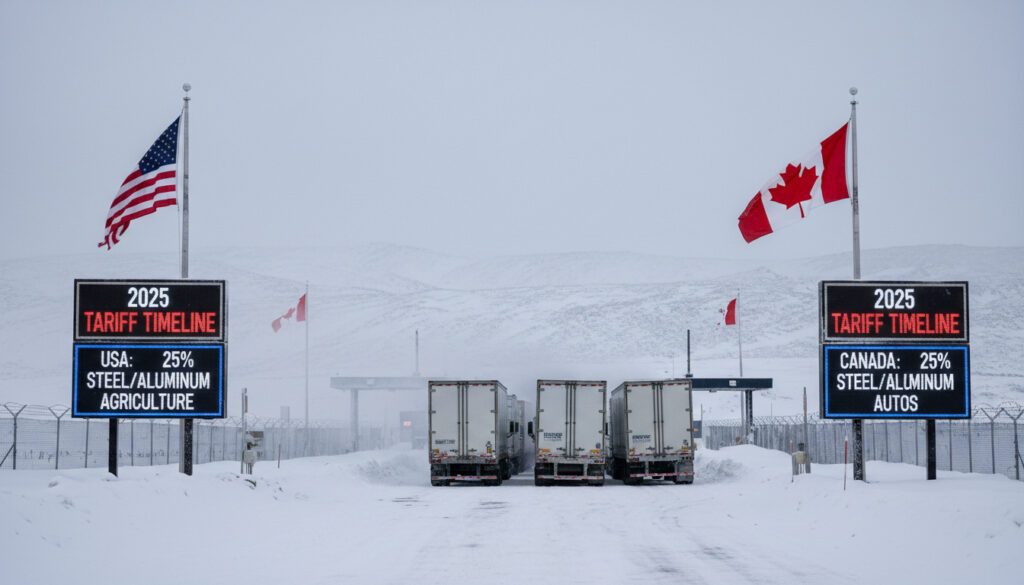
U.S. Tariffs on Canada – 2025 Timeline, Rates and Response
The United States imposed sweeping tariffs on Canadian imports throughout 2025, fundamentally altering North American trade flows. Beginning with 25% duties on most goods effective March 4, the measures invoked the International Emergency Economic Powers Act to address administration concerns regarding border security, fentanyl trafficking, and migration patterns. Energy products received a reduced 10% rate, while subsequent escalations raised general rates to 35% by August and introduced 50% duties on copper.
These actions built upon existing Section 232 tariffs on steel and aluminum, creating a complex framework of duties and exemptions. While White House directives cited national security emergencies, the practical impact was partially mitigated by United States-Mexico-Canada Agreement exemptions that preserved tariff-free status for over 85% of bilateral commerce as of late summer 2025.
The following analysis examines the tariff structure, implementation chronology, economic consequences, and the resulting trade conflict between the neighboring economies.
What Are the U.S. Tariffs on Canada?
| General Rate | 25% (increased to 35% August 1, 2025) |
| Energy Rate | 10% (oil, gas, electricity) |
| Effective Date | March 4, 2025 (initial), with phased escalations |
| Legal Basis | IEEPA (International Emergency Economic Powers Act) |
- Invocation of IEEPA marked a departure from traditional Section 232 trade remedies, citing fentanyl and migration emergencies.
- USMCA-compliant goods maintained exemption status, shielding the majority of cross-border trade from immediate duty impacts.
- Automotive sector faced 25% tariffs on non-compliant vehicles and parts, threatening integrated North American supply chains.
- Copper imports saw a 50% tariff rate imposed effective August 1, targeting a critical manufacturing input.
- Canada prepared proportional retaliation totaling up to C$155-billion across multiple product categories.
- Historical precedents from 2018 steel and aluminum disputes influenced the defensive legal frameworks invoked by both nations.
| Measure | Details |
|---|---|
| Initial General Tariff | 25% ad valorem |
| Energy Products | 10% rate (reduced from general rate) |
| Implementation Authority | Executive Order under IEEPA |
| Primary Exemption | USMCA/CUSMA-compliant goods |
| Automotive Tariffs | 25% (April 3, 2025; non-compliant content only) |
| Steel/Aluminum | 25% (March 12, 2025, Section 232 basis) |
| Copper Tariffs | 50% (August 1, 2025) |
| Retaliation Value (Canada) | Phase 1: C$30-billion; Potential Phase 2: C$125-billion |
| Trade Coverage | 85%+ tariff-free under USMCA exemptions |
When Did the U.S. Tariffs on Canada Take Effect?
The tariff regime activated on , following a 30-day delay negotiated after initial executive orders signed February 1. President Trump had initially announced the measures for February 4, but postponed implementation following commitments from Prime Minister Trudeau regarding 10,000 personnel for border security operations.
Initial Implementation Phase
The March 4 activation imposed the 25% general rate and 10% energy rate simultaneously with Canadian countermeasures. Documentation confirms this date marked the formal beginning of the 2025-2026 trade war period, with both nations exchanging surtax orders on billions in goods.
Subsequent Escalations
March 6 brought critical exemptions for USMCA-compliant goods, while March 12 saw additional 25% duties on steel and aluminum under renewed Section 232 authorities. April 3 introduced automotive tariffs, followed by auto parts duties May 3. The timeline culminated in August 1 increases to 35% general rates and 50% copper-specific duties.
Goods meeting United States-Mexico-Canada Agreement rules of origin requirements maintained duty-free status only if properly certified; non-compliant goods faced immediate 25% assessment at the border effective March 4.
Why Is the U.S. Imposing Tariffs on Canada?
The administration justified the duties under the International Emergency Economic Powers Act, citing uncontrolled migration, fentanyl trafficking across the northern border, and broader national security vulnerabilities. These justifications marked a shift from traditional trade deficit or industrial protection rationales toward emergency economic sanctions frameworks.
Border Security and Drug Interdiction
White House fact sheets explicitly tied tariff threats to Canadian cooperation on border enforcement. The February 1 orders demanded increased personnel and technological surveillance to stem flows of synthetic opioids and undocumented migrants, with tariff implementation contingent on perceived cooperation levels.
Historical Precedent
The measures built upon 2018 Section 232 tariffs on steel and aluminum, but expanded significantly in scope and legal basis. While the 2018 actions targeted specific industrial sectors under Commerce Department national security findings, the 2025 invocation of IEEPA represented a broader, emergency-based trade restriction without the procedural safeguards of traditional Section 232 investigations.
What Is the Impact and Response to U.S. Tariffs on Canada?
The economic ramifications extended across consumer prices, manufacturing supply chains, and bilateral diplomatic relations. Canadian exporters faced immediate cost disadvantages in the U.S. market, while American consumers encountered higher prices for vehicles, metals, and agricultural products subject to Canadian retaliation.
Economic Consequences
Trade analysis indicates the duties increased costs for U.S. consumers on Canadian imports, particularly in automotive sectors where 25% tariffs applied to non-USMCA content. Canadian steel and aluminum exporters absorbed 25-35% duty burdens, though the integrated nature of North American manufacturing meant many products qualified for exemption status.
December 26, 2025 Canadian measures reduced tariff rate quotas for steel derivatives to 20% of 2024 levels for non-FTA countries, creating severe constraints on specialized steel inputs for U.S. manufacturers dependent on cross-border supply chains.
Canadian Retaliation
Ottawa responded with proportional 25% surtax orders, beginning with Phase 1 covering C$30-billion of U.S. goods effective March 4. Logistics reports confirm subsequent measures targeted automobiles (April), steel and aluminum (May), and global steel derivatives (December). The government maintained authorization for Phase 2 retaliation reaching C$125-billion should U.S. escalations continue.
Canada’s United States Surtax Order (2025-1) applied 25% duties on select products ranging from agricultural goods to consumer items, strategically targeting politically sensitive U.S. export sectors while minimizing domestic Canadian economic disruption.
USMCA Protections and Limitations
The trade agreement provided substantial protection, with documentation showing over 85% of bilateral commerce remained tariff-free through compliance mechanisms. However, the administration’s use of IEEPA rather than traditional trade law created legal ambiguities regarding dispute resolution, with no formal USMCA panel filings noted as of late 2025.
The administration suspended de minimis exemptions for certain shipments, eliminating duty-free thresholds for low-value Canadian imports that previously entered without tariff assessment.
How Has the Trade War Escalated Over 2025?
- : Trump signed executive orders imposing 25% tariffs (10% on energy), initially set for February 4 but delayed 30 days following border security commitments from Trudeau. Source
- : Tariffs activated at 25% general rate; Canada enacted Phase 1 retaliation on C$30-billion of U.S. goods via United States Surtax Order (2025-1). Source
- : Exemptions issued for USMCA-compliant goods, preserving tariff-free status for qualifying products. Source
- : Additional 25% tariffs imposed on steel and aluminum from all countries, including Canada. Source
- : 25% automotive tariffs applied to non-USMCA content; Canada retaliated on U.S. motor vehicles. Source
- : Auto parts faced 25% duties (CUSMA-compliant exempt except knock-down kits); Canada expanded surtaxes to steel/aluminum. Source
- : General rates increased to 35%; copper imports subject to 50% tariffs. Source
- : Canada imposed 25% tariffs on global steel-derivative imports and reduced tariff rate quotas significantly. Source
What Is Certain and Uncertain About the Tariff Situation?
| Established Facts | Unresolved Issues |
|---|---|
| Tariffs were imposed under IEEPA citing border security and drug trafficking | Potential for further escalation to 50% general rates remains unspecified |
| USMCA-compliant goods covering 85%+ of trade remain exempt | Phase 2 Canadian retaliation details (C$125-billion) not fully specified |
| Canada enacted C$30-billion in Phase 1 retaliation | Long-term resolution timeline remains undefined |
| Rates escalated from 25% to 35% (general) and 50% (copper) by August | Status of de minimis thresholds for small shipments unclear |
What Historical Context Frames These Measures?
The 2025 tariffs represent the most significant disruption to U.S.-Canada trade relations since the 2018 steel and aluminum disputes, but operate under distinctly different legal frameworks. While the 2018 actions utilized Section 232 of the Trade Expansion Act requiring Commerce Department national security findings, the 2025 measures invoked IEEPA emergency authorities, bypassing traditional statutory safeguards and Congressional notification requirements.
The United States-Mexico-Canada Agreement, which replaced NAFTA in 2020, provided the structural framework for exemptions that prevented broader economic damage. However, the administration’s reliance on emergency economic powers rather than the agreement’s built-in dispute resolution mechanisms created novel legal tensions. Historical patterns suggest such tariff regimes typically require 12-24 months for stabilization, whether through negotiated settlement, WTO adjudication, or domestic political reversal.
Investors monitoring these developments might consider strategies discussed in How to Invest in Stocks – Beginner’s Step-by-Step Guide to navigate volatile trade policy environments.
What Have Officials Said About the Dispute?
“Canada will respond.”
Prime Minister Justin Trudeau, regarding proportional retaliation measures
“Tariffs unless they stop the invasion.”
President Donald Trump, linking tariff implementation to border security metrics
What Is the Current Status of U.S.-Canada Trade Relations?
As of late 2025, the tariff architecture remains active with no comprehensive resolution achieved. Bilateral trade continues at reduced volumes under the shadow of 35% general duties and 50% copper rates, mitigated only by extensive USMCA exemptions. Canada maintains authorization for expanded C$125-billion retaliation while both nations face sustained pressure from manufacturing sectors dependent on integrated supply chains. Monitoring Gold Rate in Canada Today 22 Carat – Live CAD Prices and Trends provides additional economic indicators reflecting these trade tensions.
How will U.S. tariffs affect prices for American consumers?
Vehicle and metal prices increased as 25-35% duties on Canadian inputs raised manufacturing costs. However, USMCA-compliant products avoided tariffs, limiting widespread inflation.
Does USMCA completely protect Canadian goods from tariffs?
No. While over 85% of compliant trade remains duty-free, non-compliant goods and specific sectors like copper face 25-50% rates. Compliance requires strict rules-of-origin documentation.
Which products face the highest U.S. tariff rates?
Copper imports face 50% duties effective August 2025. General goods face 35%, while energy products maintain a reduced 10% rate. Steel and aluminum face 25% under Section 232.
How did Canada retaliate against U.S. measures?
Canada imposed 25% surtaxes on C$30-billion of U.S. goods initially, expanding to automobiles and steel. Phase 2 authorization covers C$125-billion in potential additional retaliation.
Are automotive supply chains affected by the tariffs?
Yes. Non-USMCA automotive content faces 25% duties, affecting integrated North American production. Knock-down kits and certain parts received specific exemptions under CUSMA rules.
What legal authority allows these emergency tariffs?
The International Emergency Economic Powers Act (IEEPA) provided authority, citing national emergencies regarding fentanyl trafficking and migration rather than traditional trade statutes.
Have the tariffs impacted Canada’s currency or commodities?
Trade uncertainty has influenced cross-border investment flows. Gold and commodity markets reflect these tensions, with investors tracking live Canadian gold rates as economic indicators.
More related posts
 33 cm to inches: 12.992 exact conversion + table & visuals
 Craft Store Near Me: Top Ireland Shops & 2026 Trends
 Joseph Baena: Career, Family & Life as Schwarzenegger’s Son
 The Amazing World of Gumball – Complete Guide to Characters and Series
 Roman Polanski: Biography, Legal Status & Verified Facts
 Carole Radziwill: Marriage, Kennedy Ties, and Life After
 Quebec Forest Fires 2025: Current Status, Maps, Restrictions
 Emily Osment: Miley Cyrus Feud, Marriage & Divorce