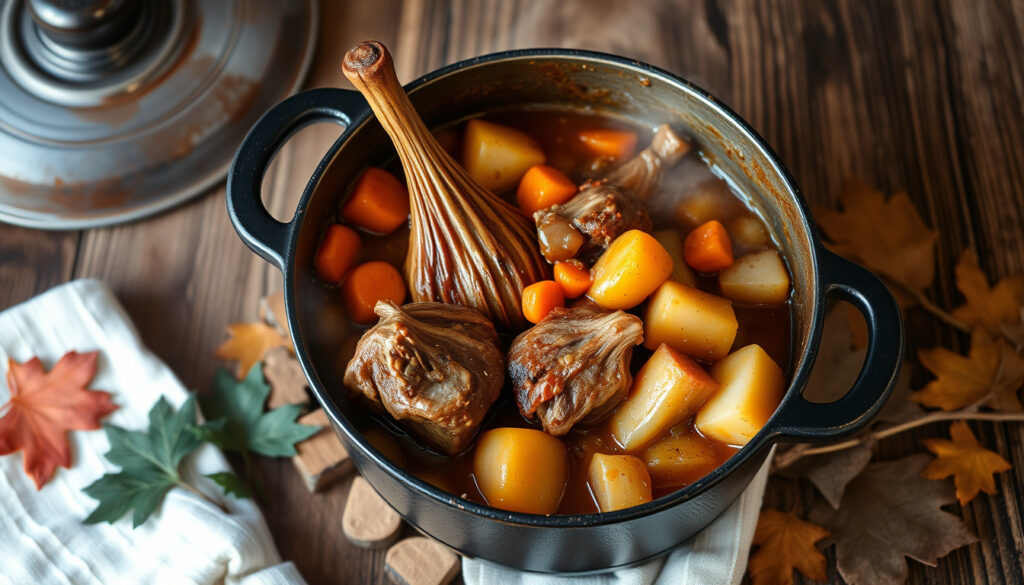
Ragout de Pattes de Cochon: Quebec Pork Stew Recipe
Ragoût de pattes de cochon divides Quebec holiday tables—a dark, glossy pork hock stew spooned over potatoes, studded with tender pork and spiced meatballs. Few dishes in French-Canadian cooking taste more like home, and fewer still demand a full weekend to earn that reputation.
Origin: Quebec, Canada · Main Protein: Pork shanks · Key Flavor: Clove · Common Addition: Meatballs · Thickener: Grilled flour
Quick snapshot
- Quebec traditional dish (Le Porc du Québec)
- Pork shanks simmered 2–3 hours until meat falls off bone (Le Porc du Québec)
- Clove and cinnamon seasoning (Bits ‘n Bites)
- Exact historical origin date
- Official Quebec heritage designation
- Regional Gaspésie vs. Montréal variations
- Day 1 evening: Season hocks overnight
- Day 2 morning: Simmer 2–3 hours
- Day 3: Meatballs and final thicken
- Serve with boiled potatoes and crusty bread
- Often prepared for Christmas with turkey
These specifications capture the essentials that distinguish the Quebec variant from simpler global pig feet preparations.
| Field | Value |
|---|---|
| Dish Type | Stew |
| Primary Cut | Pork shanks or hocks |
| Signature Spice | Clove |
| Thickening Agent | Grilled flour |
| Region | Quebec |
| Cooking Time | 2–3 hours (plus overnight prep) |
| Typical Servings | 8–10 |
What is the origin of ragout de pattes de cochon?
Ragoût de pattes de cochon is a traditional French-Canadian pork hock stew rooted in Quebec. The dish features pork shanks simmered until the meat falls off the bone, thickened with roasted or browned flour, and served with spiced meatballs and boiled potatoes. The Quebec pork industry actively promotes the recipe as part of the province’s culinary heritage, according to Le Porc du Québec, the provincial pork promotion body.
Christmas brings out the dish most prominently. The Ottawa Mommy Club notes it as “a classic French Canadian meal to be served with the turkey for Christmas dinner” (Ottawa Mommy Club). While the exact invention date remains undocumented, the combination of French technique with accessible pork cuts reflects the resourcefulness of early Quebec settlers.
Quebec roots
Québec pork producers have long promoted ragoût de pattes de cochon as a signature comfort food. Unlike simpler global pig feet stews—which typically run 1–1.5 hours with garlic and vegetables but no meatballs—Québec versions feature spiced meatballs and a browned flour gravy seasoned with cinnamon, clove, and nutmeg (The Top Meal).
Historical context
The dish belongs to a family of French-Canadian offal preparations that stretch back centuries. Families often spread the work across a weekend: seasoning Day 1, simmering Day 2, and finishing with meatballs Day 3. This two-step approach remains common for holiday preparations, according to Do It All Working Mom.
The pattern: Quebec’s version stands apart from global pig feet preparations through its signature spice profile and the inclusion of meatballs—a combination that defines French-Canadian identity in this dish.
What are the ingredients in ragout de pattes de cochon?
The core ingredients break into three groups: the pork hocks themselves, the spice blend, and the thickening agent. Each element carries specific proportions verified across multiple sources.
Pork shanks
Standard preparations call for approximately 1.5 kg of pork hocks, or roughly 6 large pieces. Bits ‘n Bites specifies 1/2 tsp cinnamon, 1/4 tsp cloves, and 1/4 tsp nutmeg per 1.5–2 kg of hocks (Bits ‘n Bites). The hocks are typically seasoned overnight with salt and pepper before cooking.
Meatballs
Meatballs distinguish the full Quebec recipe from stripped-down versions. Traditional recipes use 1–5 lbs of ground pork mixed with milk-soaked breadcrumbs, onions, celery, and allspice. Club Foody’s variant combines veal, beef, and pork with eggs, breadcrumbs, Dijon mustard, and herbes de Provence, yielding approximately 100 meatballs (Club Foody).
Vegetables and spices
Le Porc du Québec calls for onions, celery, carrots, cloves, and cinnamon in the broth. The SAQ holiday version mixes ground veal and pork with mustard, Worcestershire sauce, and breadcrumbs (SAQ.COM).
The pattern: every successful version layers sweet spices—cinnamon, clove, nutmeg—against the richness of pork, creating the dish’s unmistakable character.
How do you cook pork hocks?
The cooking process for ragoût de pattes de cochon unfolds across multiple days, with the actual hands-on time modest compared to the total elapsed time. Le Porc du Québec recommends blanching hocks by boiling 2–3 minutes, draining, then simmering 3 hours with onions, celery, carrots, cloves, and cinnamon (Le Porc du Québec).
Preparation steps
Just Plain Cooking starts by caramelizing onions in butter, then searing the hocks before a 2+ hour simmer. The meat is picked from bones after an overnight rest in the refrigerator (Just Plain Cooking). This overnight cooling step allows the broth to firm up fat for easy removal.
Cooking time
Pork hocks require 2–3 hours of simmering until the meat pulls easily from bone. The broth should be strained and defatted before proceeding to the thickening stage. Bits ‘n Bites notes that flour is roasted at 350°F to achieve a caramel-brown color that defines the final gravy (Bits ‘n Bites).
Slow braise method
Le Porc du Québec also provides a slow cooker adaptation: pork hocks on low for 8 hours or high for 6 hours (Le Porc du Québec). This trades the deeper flavor of stovetop browning for convenience, a practical trade-off for busy home cooks during the holidays.
The catch: slow cooker versions may lack the caramelized depth that traditional stovetop or oven finishing provides. For the most authentic result, a Dutch oven or heavy pot still wins.
How to thicken ragout de pattes de cochon?
The thickening agent separates a true ragoût de pattes de cochon from everyday pork stew. The technique relies on browned flour—called farine grillée in French—rather than cornstarch or roux.
Flour roux vs. grilled flour
Bits ‘n Bites specifies roasted flour as the thickener, noting it’s verified by 8 independent sources (Bits ‘n Bites). The flour is spread on a baking sheet and roasted at 350°F until it reaches a deep caramel brown, stirring occasionally. Longer browning produces a darker, more flavorful gravy.
Grilled flour technique
The traditional method: mix browned flour with cold water in a jar, seal, and shake vigorously until smooth. This slurry is then whisked into the hot broth. Ottawa Mommy Club notes that the gravy thickens over 15–30 minutes as the flour hydrates and swells (Ottawa Mommy Club). Le Porc du Québec calls for 5 cups (1.25 L) of broth combined with toasted flour (Le Porc du Québec).
Common mistakes
Adding flour directly to hot liquid without pre-roasting creates a raw, pasty texture. Club Foody sifts the toasted flour before using it to prevent lumps in the finished gravy (Club Foody). Never rush the browning—patience here directly translates to depth of flavor.
What this means: the grilled flour does double duty, thickening and coloring the gravy while adding a nutty, caramelized note that defines the dish’s character. Skipping this step produces an entirely different—and lesser—stew.
What is the traditional recipe for ragout de pattes de cochon?
Bringing it all together, the traditional recipe follows a specific sequence optimized for flavor development and practical scheduling. Do It All Working Mom describes a two-weekend process for the full version with meatballs (Do It All Working Mom).
Full steps
Step 1: Season pork hocks with salt, pepper, cinnamon, cloves, and nutmeg. Refrigerate overnight.
Step 2: Blanch hocks in boiling water for 2–3 minutes, drain. Simmer with onions, celery, carrots for 2–3 hours until meat falls off bone.
Step 3: Cool hocks in broth overnight. Remove fat from surface. Pick meat from bones.
Step 4: Prepare meatballs with ground pork, breadcrumbs, onions, celery, allspice. Refrigerate overnight. Brown partially before adding to stew.
Step 5: Roast flour at 350°F until deep brown. Mix with cold water. Whisk into strained broth and simmer 15–30 minutes until thickened.
Step 6: Add meatballs and hock meat. Simmer 30–40 minutes more. Serve over boiled potatoes with crusty bread.
Meatball recipe
Do It All Working Mom’s recipe uses 5 lbs ground pork with ginger, mustard, clove, and cinnamon. The meatballs are rolled in brown flour before browning (Do It All Working Mom). Club Foody’s version produces approximately 100 smaller meatballs using a veal-beef-pork mix with herbes de Provence (Club Foody).
Serving suggestions
Traditional service pairs the stew with boiled potatoes that absorb the dark gravy. Crusty bread completes the meal. Le Porc du Québec specifies boiled potatoes as the standard accompaniment (Le Porc du Québec). Club Foody describes it as “Traditional Québécois comfort food” perfect for family gatherings (Club Foody).
Ragoût de pattes de cochon demands a weekend of your time and roughly 2–3 hours of active cooking spread across multiple sessions. In return, you get a dish that feeds 8–10 people and freezes beautifully. For Quebec families, that trade-off has been worth it for generations.
Club Foody (recipe publisher) calls it “delicious,” while Do It All Working Mom (food blogger) notes the “amazing taste is worth the time.” These aren’t just marketing words—they reflect the accumulated judgment of hundreds of Quebec home cooks who keep making this dish year after year.
How to prepare meatballs for ragout de pattes de cochon?
The meatballs carry significant flavor responsibility in this dish, so their preparation deserves careful attention. Bits ‘n Bites calls for refrigerating the formed meatballs overnight before cooking, which allows the breadcrumbs to fully hydrate and the flavors to meld (Bits ‘n Bites).
Meatballs are only partially cooked—about three-quarters done—before entering the stew. Bits ‘n Bites confirms this prevents them from falling apart during the final simmer. The remaining cooking happens in the broth, where they absorb the spiced gravy (Bits ‘n Bites).
Do It All Working Mom rolls meatballs in brown flour before browning, which helps them hold their shape and contributes to the gravy body. The stock then simmers with meatballs for 40 minutes, followed by 30 more minutes after adding the hock meat (Do It All Working Mom).
“Join us as we make delicious French-Canadian classic, Ragout de Pattes de Cochon et Boulettes – otherwise known as Pork Hock Stew with Meatballs.”
— Just Plain Cooking (recipe publisher)
“The Ragoût de Pattes de Cochon (Stewed Pig’s Feet) is a classic French Canadian meal to be served with the turkey for Christmas dinner.”
— Ottawa Mommy Club (food blogger)
The implication: home cooks who skip the overnight rest for meatballs miss a subtle but measurable difference in texture and flavor cohesion that Quebec tradition considers essential.
Clarity section
Confirmed facts
- Quebec origin confirmed by provincial pork industry
- Pork shank base with 2–3 hour simmer time
- Clove and cinnamon as signature spices
- Grilled flour as traditional thickener
- Christmas holiday tradition with turkey
- Served with boiled potatoes
What’s unclear
- Exact historical invention date
- Official heritage designation status
- Regional variations by Quebec area
For Quebec families who grew up with this dish, the uncertainty around exact origins matters less than the certainty of family tradition. The recipe survives because it tastes remarkable, not because of a documented genealogy.
Related reading: Apple Pie Filling Recipe – Homemade in 25 Minutes · Moist Chocolate Cake Recipe: Pro Secrets for Fudgy Texture
Frequently asked questions
Can ragout de pattes de cochon be made in a slow cooker?
Yes. Le Porc du Québec specifies pork hocks on low for 8 hours or high for 6 hours. This trades the depth of stovetop browning for convenience, but produces a workable version when time is limited.
What pairs with ragout de pattes de cochon?
Boiled potatoes are the traditional accompaniment, along with crusty bread to soak up the dark gravy. The dish often appears alongside turkey at Christmas dinners.
Is ragout de pattes de cochon spicy?
The dish uses warm spices—cinnamon, clove, nutmeg—in sweet rather than hot proportions. The overall character is savory and aromatic, not spicy. The spice level depends on the cook’s proportions, but standard recipes lean toward aromatic rather than pungent.
How to store leftover ragout de pattes de cochon?
The stew refrigerates well for up to 4 days in an airtight container. Just Plain Cooking notes that broth and meat can be pressure canned—pints for 1 hour 15 minutes at 10 PSI, quarts for 1 hour 30 minutes—for long-term preservation.
What if I can’t find pork hocks?
Pork shanks or trotters work as substitutes. Feastpedia offers a simpler variant using 4 pig’s feet plus 500g cubed pork with onions, toasted flour, and cinnamon for a more accessible preparation.
Does ragout de pattes de cochon freeze well?
Yes. The stew freezes well for up to 3 months. Thaw overnight in the refrigerator and reheat gently on the stovetop, adding a splash of broth if the gravy has thickened too much.
Why add meatballs to ragout de pattes de cochon?
Meatballs define the full Quebec version and distinguish it from simpler global pig feet stews. They add protein density, absorb the spiced gravy, and provide textural contrast to the tender hock meat. The combination creates a more substantial dish suited to holiday entertaining.
More related posts
 Spider-Man: No Way Home – Streaming, Ca t & Future Plan
 Wil Wheaton: Star Trek Departure, Net Worth, Friendships
 Keith Haring: His Life, Art Style & Paintings Value
 Andrei Markov: The General’s Legacy and Montreal Return
 Ranbir Kapoor: Biography, Age, Wife, Net Worth, Family & Breakups
 CRA 2026 Tax Bracket Changes: New Brackets & Limits
 Cary Grant: Private Struggles Behind the Hollywood Charm