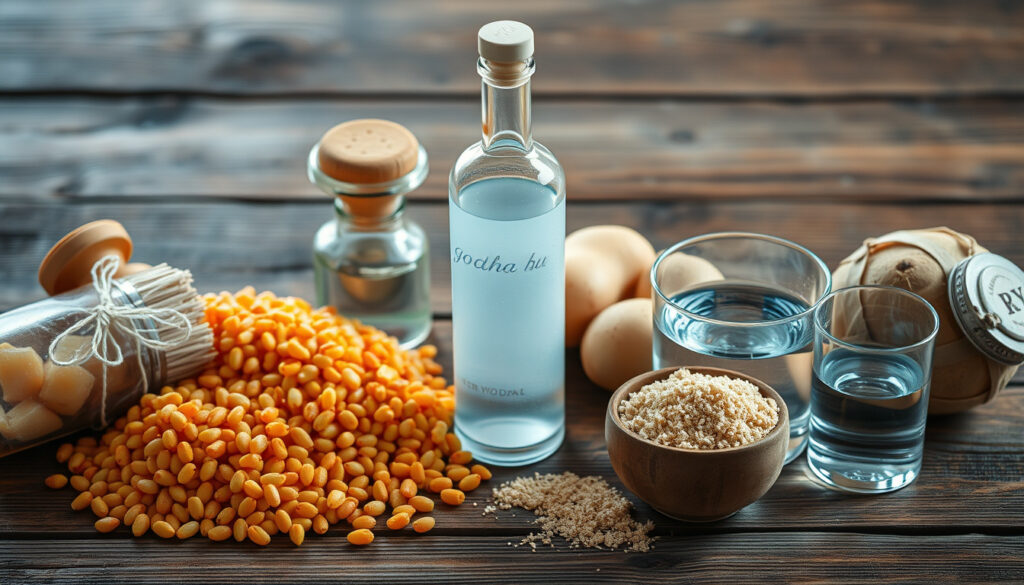
What Is Vodka Made From? Ingredients, Grains, Potatoes & Health
You’ve probably heard that vodka is made from potatoes — but the truth is far more flexible. In fact, vodka can be distilled from almost any fermentable crop, from wheat and rye to grapes and sugar beets. This guide breaks down what goes into your bottle, how the base ingredient changes the spirit, and what those choices mean for your health.
Minimum ABV (vodka): 37.5% EU, 40% US ·
Common bases: grains, potatoes, sugar beet molasses ·
Typical distillations: 3 to 5 ·
Calories per 1.5 oz: ≈ 97
Quick snapshot
- Most common base (Absolut (vodka producer))
- Includes wheat, rye, corn, barley (Absolut (vodka producer))
- Produces smooth, neutral spirit (Absolut (vodka producer))
- Traditional Eastern European base (Absolut (vodka producer))
- May have slightly earthy flavor (Absolut (vodka producer))
- Often gluten-free (Absolut (vodka producer))
- Used in some commercial vodkas
- High sugar content for fermentation
- Example: Luksusowa
- Includes grapes, rice, soybeans (Chuckanut Bay Distillery (craft distillery))
- Less common (Chuckanut Bay Distillery (craft distillery))
- Often marketed as craft vodkas (Chuckanut Bay Distillery (craft distillery))
Six key facts that define vodka’s legal identity and nutritional profile:
| Attribute | Value |
|---|---|
| Alcohol content (US) | Minimum 40% ABV (80 proof) |
| Alcohol content (EU) | Minimum 37.5% ABV |
| Standard serving size | 1.5 ounces (44 ml) |
| Calories per serving | Approximately 97 |
| Carbohydrates per serving | 0 grams |
| Sugar per serving | 0 grams |
The implication: vodka offers a calorie-dense, carbohydrate-free alcohol option — but its legal definition as a neutral spirit means almost any crop can be the canvas.
What is the main ingredient in vodka?
The core legal reality is that vodka is primarily water and ethanol. The U.S. TTB (federal alcohol regulator) defines it as “neutral spirits distilled from any material at or above 95% alcohol by volume” (Chuckanut Bay Distillery quoting TTB). That means any fermentable carbohydrate can serve as the main ingredient. In practice, grains dominate.
Grains: the most common base
- Wheat, rye, corn, and barley are the most widely used (Absolut (vodka producer)).
- Wheat vodka is described as soft and lightly sweet (Minuman (liquor education site)).
- Rye vodka offers a spicier, firmer profile (Minuman (liquor education site)).
Potatoes: a traditional source
- Potatoes are a historic base, especially in Eastern Europe.
- Only about 3% of vodka sold globally is potato-based (Absolut (vodka producer)).
- Potato vodka is often fuller-bodied and creamy (Minuman (liquor education site)).
Sugar beet molasses and other crops
- Sugar beet molasses is a common base in large-scale production because of its high fermentable sugar content.
- Other crops like grapes, rice, and soybeans are less common but used in craft vodkas (Chuckanut Bay Distillery (craft distillery)).
Potatoes yield less alcohol per pound of raw material than grains, making them less efficient — but they produce a distinctive creamy mouthfeel that some drinkers prefer.
The pattern: flexibility of base crops is vodka’s defining advantage, but also why “cleanest” claims need careful scrutiny.
Is vodka actually made from potatoes?
Yes — but not as often as you might think. While the potato-Vodka connection is strong in popular culture, grain-based vodka is far more common.
Potato vodka vs. grain vodka
- Potato vodka can be gluten-free, while grain vodka (unless made from corn or rice) may contain trace gluten.
- Grain vodka tends to be more neutral; potato vodka may retain a slight earthy character (Absolut (vodka producer)).
Does potato vodka taste different?
Many distillers and reviewers note that potato vodka has a nutty, earthy, or creamy quality compared with grain vodkas (Minuman (liquor education site)). However, because vodka is defined as “without distinctive character” (per U.S. TTB rules), these differences are subtle.
Which alcohol is made of potatoes?
Besides vodka, potato-based spirits include certain schnapps and akvavit. But vodka is by far the most widespread potato-derived alcohol. Brands like Luksusowa and Chopin are well-known potato vodkas.
The catch: marketing often exaggerates the “potato” heritage, while most mass-market vodkas are grain-based for cost and consistency.
What is Grey Goose vodka made from?
Grey Goose is one of the most recognized premium vodka brands. Its ingredient story is tightly linked to a specific region in France.
The wheat source: Picardy, France
Grey Goose uses soft winter wheat grown in the Picardy region of northern France — an area known for high-quality wheat (Grey Goose (official brand)).
Grey Goose production process
- The vodka is distilled in Cognac, France.
- It undergoes a five-step distillation process (including a final column distillation) to achieve a smooth, neutral spirit.
Why this matters: the “single-origin” claim sets Grey Goose apart from blended bulk vodkas, but the health impact of any vodka depends far more on how much you drink than on the wheat’s geography.
How unhealthy is vodka?
Vodka itself contains no carbohydrates, sugar, or fat — but that doesn’t mean it’s risk-free.
Vodka’s nutritional profile
- Zero carbs and zero sugar per standard serving (WebMD (health information publisher)).
- About 97 calories per 1.5 oz pour.
Health risks of vodka consumption
- Excessive drinking is linked to liver disease, addiction, and an increased risk of certain cancers (WebMD (health information publisher)).
- Moderate consumption (1 drink/day for women, 2 for men) may carry some cardiovascular benefits according to some studies, but the evidence is mixed.
Is vodka the worst alcohol for you?
Compared with sugary cocktails, beer, or wine, vodka has fewer calories and no carbohydrates. However, any alcohol consumed in excess is harmful. The “worst” alcohol is usually the one consumed most heavily.
For those with irritable bowel syndrome or gluten sensitivity, grain-based vodka may trigger symptoms — potato or grape-based alternatives could be easier on the gut.
The trade-off: vodka offers a clean nutritional label, but its health impact is dominated by the alcohol content, not the crop.
What is the cleanest vodka in the world?
The term “clean” usually refers to minimal impurities, fewer additives, and a high degree of filtration. But no official standard exists.
What defines ‘clean’ vodka?
- Multiple distillations and charcoal filtration remove congeners (impurities) that can cause hangovers.
- Some brands claim “cleanest” based on low methanol content or organic certifications.
Grain-free vodka and gut health
- Potato, grape, and sugarcane vodkas are naturally gluten-free and may be better tolerated by people with gluten sensitivity.
- Anecdotal reports suggest grain-free vodkas cause less bloating, but scientific data is limited.
Healthier vodka alternatives
- Vodkas made from grapes (e.g., Cîroc) or potatoes (e.g., Chopin) are marketed as cleaner for the stomach.
- Organic vodkas avoid synthetic pesticides, which some consumers consider healthier.
The catch: no independent, peer-reviewed ranking of “cleanest” vodka exists. The best choice depends on your personal digestive tolerance, not the label’s claim.
What we know and what’s still unclear
- Vodka is distilled from any fermentable carbohydrate (Absolut (vodka producer)).
- Grains and potatoes are the two most common bases.
- Grey Goose uses soft winter wheat from France.
- Absolut vodka is made from winter wheat in Sweden.
- Standard serving contains 0 g carbs, 0 g sugar (WebMD (health information publisher)).
- Exact health benefits of “cleanest” vodka marketing claims.
- Which specific vodka brand is definitively the healthiest — no peer-reviewed comparison exists.
- Whether grain-free vodka significantly improves gut health for non-celiac individuals.
Quotes from industry and health experts
Vodka can be distilled from almost any sugar-rich or starchy agricultural material, including grains, potatoes, sugar beet molasses, grapes, and other raw materials.
— Absolut (vodka producer)
The most common vodka base ingredients today are grains, especially wheat and rye, while potatoes are less common globally.
— Absolut (vodka producer)
Vodka made from potatoes is often described as having a nutty or earthy character compared with fruit-based vodkas.
— Absolut (vodka producer)
Alcohol is a toxin. Even moderate consumption carries risks, especially for liver health and cancer.
— WebMD (health information publisher)
The pattern: producers emphasize ingredient flexibility; health sources stress alcohol’s inherent risk. Both are true — and your choice depends on which trade-off matters more.
Summary: The real takeaway
Vodka’s strength — and marketing challenge — is its raw-material flexibility. Whether from wheat, potato, or sugar beet, the end product is a neutral spirit that differs only subtly in flavor and mouthfeel. Health-wise, the ingredient matters far less than the amount you drink. For consumers in the US concerned about gut sensitivity, the smart move is to choose a potato or grape vodka and keep servings moderate. For everyone else, the “cleanest” vodka is simply the one you enjoy responsibly — or skip entirely if health is the priority.
If you’re curious about how alcohol affects your body beyond vodka, you might find our guide on What Is the Best Liver Food? helpful. And for a non-alcoholic treat, try our Apple Pie Filling Recipe.
För den som undrar vad vodka egentligen är gjord av kan det vara intressant att prova en vodka pasta utan vodka för att förstå hur smaken kan ersättas i matlagning.
Frequently asked questions
What is the difference between vodka made from grain and potato?
Grain vodka is lighter and more neutral; potato vodka tends to be creamier and slightly earthy. Both can be distilled to similar purity.
Can vodka be made from fruit?
Yes, fruit-based vodkas exist (e.g., Cîroc from grapes). They are less common but can offer a fruitier profile.
What does ‘distilled’ mean in vodka production?
Distillation is the process of heating fermented liquid to separate alcohol from water and impurities, then condensing the vapor back into liquid.
Is all vodka gluten-free?
No. Vodka made from wheat, rye, or barley may contain trace gluten, though distillation removes most proteins. Potato or corn vodka is gluten-free.
How many times is vodka distilled?
Premium vodkas are typically distilled 3 to 5 times. More distillations produce a smoother spirit but also remove flavor compounds.
What is the origin of vodka?
Vodka originated in Eastern Europe, likely in Poland or Russia, in the 14th or 15th century. The word “vodka” comes from Slavic *voda* (water).
Which country produces the most vodka?
Russia is the largest producer, followed by the United States and Poland. Major brands include Smirnoff (US) and Absolut (Sweden).
More related posts
 Gord Downie: Biography, Cause of Death, and Legacy
 Nick Cave’s Children: Grief, Tragedy, and Loss — Full Story
 Buffalo Bills vs Denver Broncos – Head-to-Head Record & Playoff History
 Apple Pie Filling Recipe – Homemade in 25 Minutes
 Cary Grant: Private Struggles Behind the Hollywood Charm
 Andy Byron Astronomer: CEO Resignation After Coldplay
 Maud Lewis: Biography, Paintings, Daughter & Husband Truth
 What Is the Best Liver Food? Top Foods for Repair & Detox