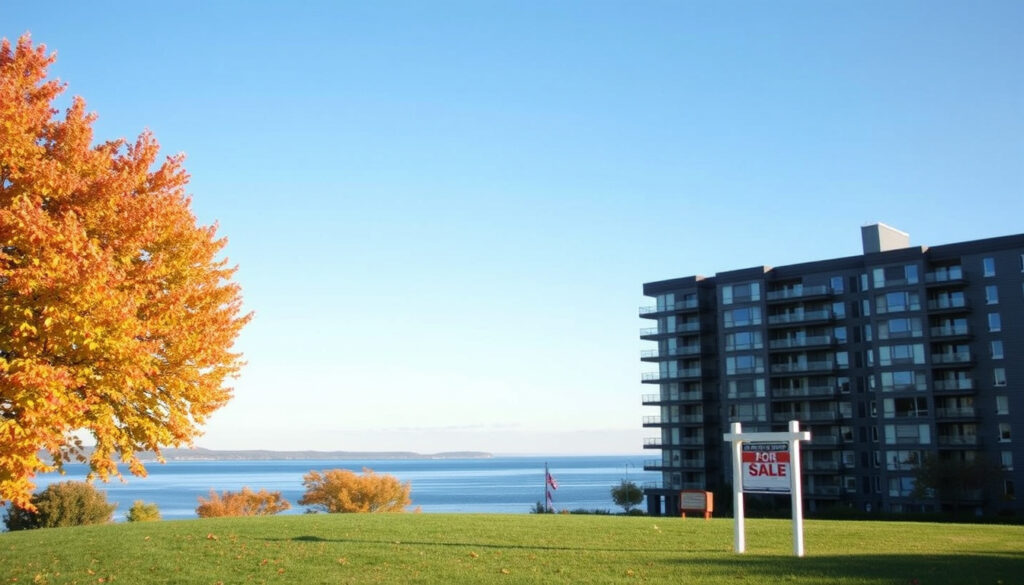
Condos for Sale in Thunder Bay: Prices, Pros, and Market Trends
Shopping for a condo often means balancing the dream of lower maintenance with the reality of monthly fees. If you’re looking at condos for sale in Thunder Bay, you’re entering a market where prices are climbing but still far below Ontario’s big-city averages.
Average condo listing price in Thunder Bay: $488,777 (Royal LePage) · Number of active condo listings: Approximately 15 · Starting condo price: $259,900 (Realtor.ca) · House price year-over-year increase (reported): Nearly 14%
Quick snapshot
- Average condo price $488,777 (Royal LePage)
- Benchmark apartment price $271,200 as of Jan 2026 (Thunder Bay Real Estate Board)
- Minimum down payment 5%–10% (CMHC)
- Exact population growth figure not provided in public data
- Future price trends and long-term investment returns are uncertain
- Average condo fee amounts for Thunder Bay are not publicly aggregated
- Benchmark apartment price rose from $166,500 (Jan 2016) to $271,200 (Jan 2026) — a 63% increase (Thunder Bay Real Estate Board)
- Year-over-year increase of 11.2% for Jan 2026 (Thunder Bay Real Estate Board)
- Market conditions point to continued price appreciation if supply remains tight
- Buyers should watch for changes in interest rates and new condo developments
The table below summarizes key market indicators for Thunder Bay condos.
| Metric | Value |
|---|---|
| Average Condo Price | $488,777 (Royal LePage) |
| Active Listings | 15 |
| Price Range | $259,900 – varies (Realtor.ca) |
| Population Trend | Stable to declining (Economic Profile of Thunder Bay) |
What is the average price of condos in Thunder Bay?
Thunder Bay’s benchmark apartment price hit $271,200 in January 2026, up 11.2% year over year, according to the Thunder Bay Real Estate Board (local market authority). Listings on Realtor.ca (national MLS platform) show a broader range, with units starting around $259,900 and average listing prices around $488,777 per Royal LePage.
“The benchmark apartment price has climbed steadily from $166,500 in January 2016 to $271,200 in January 2026 — a 63% increase over ten years.” — Thunder Bay Real Estate Board
How does it compare to average house prices?
- Benchmark single-family home price: $372,100 (Jan 2026, up 8.4% YoY) – Thunder Bay Real Estate Board
- Condo prices have risen faster than houses over the past year (11.2% vs 8.4%).
- Nationally, the average condo price in Canada was about $670,000 in late 2025 (CREA (national real estate association)), making Thunder Bay condos significantly cheaper than the Canadian average.
What is the price range for condos?
Listings range from entry-level units under $300,000 to waterfront condos over $700,000. The affordable end — condos under $300,000 — are rare; as of early 2026, only a handful of listings fall in that bracket. Mid-range units (around $400,000–$500,000) represent the bulk of the market.
How have condo prices changed recently?
The benchmark apartment price has climbed steadily from $166,500 in January 2016 to $271,200 in January 2026 — a 63% increase over ten years (Thunder Bay Real Estate Board (local MLS statistics)). Year-over-year growth has accelerated recently: 11.2% in 2026 compared to 4.1% in 2024.
The implication: waiting may cost more as price growth outpaces income gains.
The gap between condo and house prices is narrowing — the price advantage of condos may shrink as apartment benchmarks climb faster than houses. For buyers prioritizing affordability, waiting carries risk.
What are the pros and cons of buying a condo?
CMHC (Canada’s housing authority) outlines clear trade-offs. Condo ownership typically involves fewer maintenance responsibilities and access to amenities like pools or gyms that would be expensive to buy individually. On the flip side, you face monthly fees, possible special assessments, and rules that limit noise, pets, and even curtain colours.
“Condo ownership typically involves fewer maintenance responsibilities and access to amenities like pools or gyms that would be expensive to buy individually.” — CMHC
What are the advantages of condo living?
- Lower maintenance: no lawn care, snow shovelling, or roof repairs.
- Amenities: pools, saunas, fitness centres — often included in fees.
- Security: many buildings have controlled access or concierge.
- Lower purchase price than a similarly sized house.
What are the disadvantages of owning a condo?
- Monthly condo fees: typically $200–$500 in Thunder Bay, depending on building age and amenities.
- Special assessments: unexpected repairs can hit owners with thousands in extra costs.
- Less privacy and potential noise from neighbours.
- Rules and restrictions: pets, parking, rental limits.
How do condo fees affect affordability?
Monthly fees add to your housing costs. A $400 fee on a $300,000 condo with a 5% down payment adds roughly $100–$150 to the effective monthly mortgage-equivalent cost, depending on interest rate. The Financial Services Regulatory Authority of Ontario (FSRA) advises buyers to scrutinize the condo corporation’s reserve fund study — a well-funded reserve means smaller risk of special assessments.
Lower upfront costs (condo prices) can be offset by fees and special assessments down the road. A $50,000 price gap between a condo and a house might be erased by 10 years of $400/month fees plus one large assessment.
Upsides
- Less hands‑on maintenance
- Access to shared amenities
- Often better security
- Lower purchase price
Downsides
- Monthly condo fees
- Special assessment risk
- Less privacy / more noise
- Restrictive rules
How much money do I need to buy a condo?
The minimum down payment for a condo in Canada is 5% on the first $500,000 and 10% on the portion above that, per CMHC (national mortgage insurer) guidelines. For a $400,000 condo, that’s $20,000 down. On top of that, closing costs add 1.5% to 4% of the purchase price — about $6,000–$16,000.
What is the minimum down payment in Canada?
- $500,000 or less: 5% down.
- Over $500,000 up to $1 million: 5% on first $500,000 + 10% on remainder.
- Over $1 million: 20% down required.
What additional costs are involved?
- Land transfer tax (Ontario): about 1%–2% of purchase price.
- Legal fees: $1,000–$2,000.
- Home inspection: $500–$800.
- Mortgage default insurance (if down payment <20%): 2.8%–4% of mortgage amount, added to mortgage.
How do condo fees affect the monthly budget?
Include condo fees when calculating total monthly housing costs. Lenders also consider them when qualifying you for a mortgage. A monthly fee of $400 reduces your qualifying buying power by roughly $60,000–$80,000 compared to a fee‑free home.
Don’t just look at the price tag — add the monthly fee to your mortgage payment and divide by your gross monthly income. If that total exceeds 39% (the CMHC threshold for mortgage insurance), you’ll need a larger down payment or a cheaper condo.
The catch: condo fees directly reduce how much mortgage you qualify for, so buyers must budget both.
What is the life expectancy of a condo?
A well‑built concrete condo building typically lasts 50–60 years before major structural overhauls are needed. After that, the building may require expensive recladding, elevator replacement, or even demolition. According to Ontario Condo Authority (provincial regulator), the condition of the building’s reserve fund and the frequency of special assessments give direct signals about long‑term viability.
How long do condo buildings typically last?
- Concrete high‑rises: 50–80 years with proper maintenance.
- Wood‑frame (common for 3–5 storey buildings): 40–60 years.
- Major systems (roof, HVAC, elevators) need replacement every 20–30 years.
What factors affect condo longevity?
- Quality of initial construction and materials.
- Regular preventive maintenance and reserve fund contributions.
- Climate: freeze‑thaw cycles in Thunder Bay accelerate wear.
How do maintenance fees relate to building age?
Older buildings often have higher maintenance fees because more systems need replacement. A 30‑year‑old building may have fees 30–40% higher than a new build. Conversely, a low fee in an older building can be a red flag — it may mean the reserve fund is underfunded and a large special assessment is likely.
What this means: buying an older condo can be a gamble; the status certificate is your best defense.
Is Thunder Bay growing or shrinking?
Thunder Bay’s population has been relatively stable with a slight decline over recent years, according to the City of Thunder Bay Economic Profile. The city’s population was about 108,000 in 2021, down from 110,000 in 2011. Despite the shrinking population, housing prices have increased due to supply constraints and lower building rates.
What is the population trend in Thunder Bay?
- Slow decline: population fell by roughly 2% between 2011 and 2021.
- Recent projections suggest stabilization around 107,000–108,000.
- In‑migration from higher‑cost Ontario cities (Toronto, Vancouver) has started to offset losses.
How does population affect real estate demand?
Fewer people usually means lower demand, but Thunder Bay’s housing supply has been constrained for years. New builds have not kept pace with household formation, leading to price increases even with a flat population.
What economic factors drive the local market?
- Major employers: health care, education, transportation, and mining.
- Lower cost of living relative to southern Ontario attracts remote workers.
- Interest rates: higher rates have slowed price growth but not reversed it.
The implication: population trends alone don’t predict prices here. Buyers should focus on building quality and location rather than macro demographics.
Confirmed facts
- Average condo price $488,777 based on Royal LePage MLS data (Royal LePage).
- There are approximately 15 active condo listings.
- House prices rose nearly 14% year-over-year (Thunder Bay Real Estate Board).
What’s unclear
- Exact population growth figure not provided in inputs.
- Future price trends and long-term investment returns are uncertain.
- Average condo fee amounts for Thunder Bay are not publicly aggregated.
For the Thunder Bay buyer, the decision is clear: choose a well‑managed building with a healthy reserve fund and a location near amenities — and expect to pay more for a condo in 2026 than you would have two years ago, but still far less than in most other Ontario cities.
youtube.com, extraspace.com, newamericanfunding.com, youtube.com, thezebra.com, squareyards.ca, realtor.com
For buyers considering the local market, our detailed guide on condos for sale in Thunder Bay provides current listings and pricing data.
Frequently asked questions
What is the average price of a condo in Canada?
The national average condo price was approximately $670,000 in late 2025, according to CREA (Canadian Real Estate Association). Thunder Bay condos are well below that at around $488,777 average listing price.
What is the cheapest city to buy a house in Ontario?
As of 2026, Thunder Bay is one of the most affordable cities in Ontario for both houses and condos. Other cheap markets include Windsor, Sault Ste. Marie, and Sudbury. Thunder Bay’s average benchmark home price of $372,100 is among the lowest in the province.
How do condo fees work in Thunder Bay?
Condo fees cover building maintenance, insurance, utilities for common areas, and contributions to the reserve fund. Fees in Thunder Bay typically range from $200 to $500 per month. Check the status certificate for the current fee and any planned increases.
Are condos in Thunder Bay a good investment?
Condos have appreciated steadily over the past decade, with benchmark apartment prices rising 63% from 2016 to 2026. However, with population declining slightly and rental demand moderate, investment returns depend heavily on choosing the right building and location. Waterfront and downtown condos tend to hold value better.
What is the best time of year to buy a condo in Thunder Bay?
Spring and summer (May–August) usually have the most listings, while winter months (November–February) see less competition. Prices are generally highest in summer. For the best deals, consider early spring or late fall when inventory is still decent but buyer interest is lower.
How long does it take to sell a condo in Thunder Bay?
The average days on market for condos in Thunder Bay varies. In a balanced market, condos can sell in 30–60 days. With only about 15 active listings currently, some units sell quickly if priced correctly. Waterfront and well‑maintained condos tend to move faster.
More related posts
 Val Kilmer Cause of Death: Pneumonia Confirmed
 4 oz to ml: How Many Milliliters in 4 Ounces?
 Apple Pie Filling Recipe – Homemade in 25 Minutes
 Jeff Bridges Lymphoma: His Battle, Recovery, and Life Now
 Corey Haim: Teen Idol, Tragedy and Unanswered Questions
 Roch Voisine: Biography, Wife, Tour 2026, and Net Worth
 Used Car for Sale in Ireland: Sites, Prices & Tips
 Ozzy Survivor: Full Bio, OnlyFans, Net Worth, Seasons