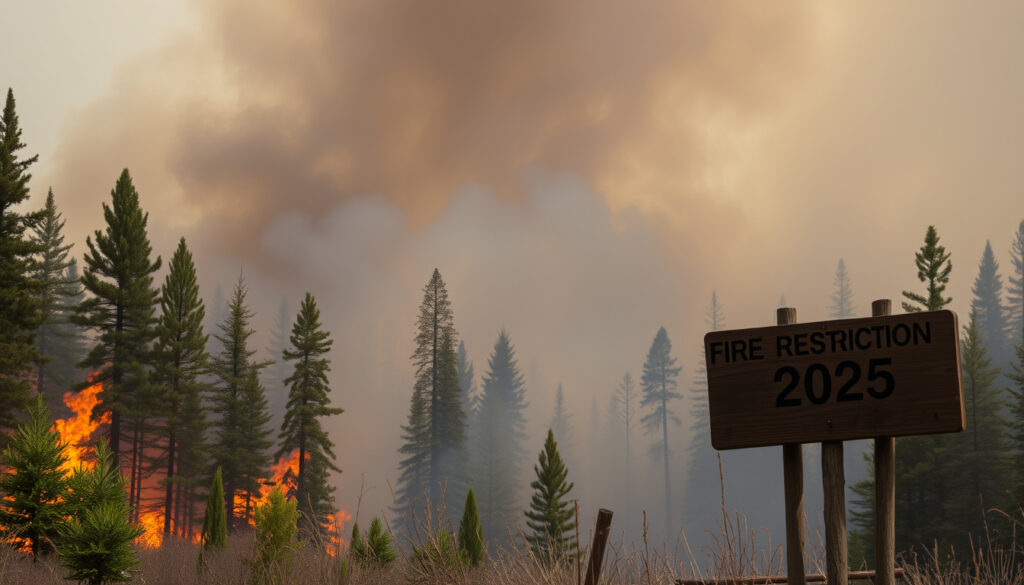
Quebec Forest Fires 2025: Current Status, Maps, Restrictions
Anyone who has spent a spring in Quebec knows that wildfire season arrives with an unsettling regularity. But the numbers this year — 527 fires fought in the intensive protection zone — tell a story that goes beyond the routine. SOPFEU, Quebec’s fire agency, reports that 87% of those 2025 fires were human-caused, a striking reminder of how much control we actually have. This article pieces together the current fire status, restrictions, maps, and expert insights to help you make sense of the season.
Average spring wildfires in Quebec: 275 ·
Percentage of May fires human-caused: 99% ·
Average annual evacuations due to wildfires in Quebec: 60 ·
Area burned in Quebec (May 2025): 136.4 hectares
Quick snapshot
- Active fires in Quebec tracked by SOPFEU (provincial fire agency)
- Total area burned in intensive protection zone: 1,313.7 hectares (SOPFEU 2025 season review)
- Number of fires reported (spring average: 275) (SOPFEU provincial situation)
- SOPFEU restriction levels: Low / Moderate / High (SOPFEU restriction map)
- Wood stove usage limitations enforced during high risk (SOPFEU 2025 season review)
- Open-fire ban imposed October 1–21, 2025 (SOPFEU season review)
- SOPFEU real‑time fire map (active fire locations and danger index)
- Natural Resources Canada fire and smoke maps (national overview)
- Données Québec provincial data repository (geospatial fire data)
- Human activity causes 99% of May fires (SOPFEU provincial situation)
- Climate and weather factors (dry spring, low snowpack) increase risk (Ouranos climate consortium)
- SOPFEU educates public through prevention campaigns
The table below captures the key metrics that define the 2025 Quebec fire season.
| Metric | Value |
|---|---|
| Average spring wildfires in Quebec | 275 (SOPFEU) |
| Percentage of May fires human-caused | 99% (SOPFEU) |
| Annual evacuations (average) | 60 (Ouranos) |
| Area burned in May 2025 (Quebec) | 136.4 hectares (SOPFEU) |
| SOPFEU restriction levels | Low / Moderate / High (SOPFEU map) |
The implication: these numbers reveal a season of many small, preventable fires rather than a few catastrophic ones.
Are there forest fires in Quebec?
Current active fires in Quebec
- As of the latest SOPFEU update, the fire danger index is low to moderate across most regions, but the situation requires attention (SOPFEU provincial situation).
- 24 forest fires were recorded between May 21 and May 24, affecting more than 45 hectares (SOPFEU).
How SOPFEU categorizes fire status
- The agency uses a three‑level danger index: low, moderate, high. During the off‑season (winter), the index is not displayed (SOPFEU warning).
- Fires are classified as “active” if they are being monitored or fought within the intensive protection zone.
What is the current situation of wildfires in Canada?
Comparison with previous years
- SOPFEU fought 527 forest fires in Quebec’s intensive protection zone in 2025, 65 fires above the average of the previous ten years (SOPFEU season review).
- The area burned — 1,313.7 hectares — is relatively low compared to national totals, but the number of fires is above average.
Impact on Quebec and other provinces
- Quebec’s fire season is part of a larger Canadian pattern; Natural Resources Canada tracks national fire statistics, and in 2025 Quebec accounted for a notable share of early‑season fires (Natural Resources Canada (federal fire monitoring)).
- Evacuations remained localized to remote communities, with no mass urban evacuations as seen in some previous years.
The pattern: Quebec’s fire season started with a high number of small, human‑caused fires, while large wildfires were concentrated in northern and western Canada.
Where are the forest fires located in Canada?
Interactive maps from SOPFEU and Natural Resources Canada
- SOPFEU’s real‑time map shows active fire locations, danger index, and restriction zones by region.
- Natural Resources Canada provides a national wildfire interactive map with smoke forecasts (NRCan wildfire maps).
Regional hotspots in Quebec
- In May 2025, fire danger rose in Abitibi‑Témiscamingue, Outaouais, Lanaudière, Laurentides, Montérégie, Mauricie, Centre‑du‑Québec, Estrie, and Chaudière‑Appalaches (SOPFEU regional update).
- Southern Quebec saw more fires due to higher human activity; northern regions had fewer but larger fires.
Quebec residents can use SOPFEU’s detailed regional map to see danger levels street‑by‑street. The tool also shows restriction zones for open fires — a must‑check before any outdoor activity.
Why are there so many wildfires in Canada right now?
Climate and weather conditions in 2025
- A dry spring with low snowpack across much of Canada created conditions conducive to wildfire ignition and spread (Ouranos (Quebec climate research consortium)).
- Ouranos research indicates that climate change is lengthening the fire season and increasing the frequency of extreme fire‑weather days.
Human activities contributing to ignition
- 87% of Quebec’s 2025 fires were caused by human activity: poorly extinguished campfires (134 fires), cigarette butts (82 fires), and burn piles (86 fires) (SOPFEU season review).
- Lightning is a natural cause, but in spring human negligence dominates.
The implication: Most Quebec wildfires are preventable. The 99% human‑caused rate in May is not a natural phenomenon — it’s a behavioural one.
Why can’t Canada control all its wildfires and what do scientists think?
Resource constraints and remote location challenges
- SOPFEU prioritises fires that threaten communities, infrastructure, or high‑value forests. Many fires in remote areas are monitored but not actively suppressed (SOPFEU (primary fire agency for Quebec)).
- Natural Resources Canada scientists note that suppression costs are high and not all ecosystems require fire exclusion — some are fire‑adapted (Natural Resources Canada (federal wildfire research)).
Role of fire‑adapted ecosystems
- Boreal forests in northern Canada have evolved with fire; suppression in those areas can disrupt natural cycles.
- Scientists from Ouranos and NRCan study how to balance suppression with letting some fires burn for ecological benefit.
Fire suppression is not always the right answer. For Quebec’s northern boreal zone, letting fires burn can reduce future fuel loads. For populated southern zones, suppression is essential — but that means more resources allocated where people live.
How to Prepare for Wildfire Season in Quebec
- Monitor SOPFEU’s danger index daily during spring and summer. The map shows restriction levels by municipality (SOPFEU fire danger map).
- Know the open‑fire regulations. An open‑fire ban was imposed October 1–21, 2025 — many violators triggered fires (SOPFEU season review).
- Extinguish campfires and cigarettes completely. In 2025, 134 fires came from campfires; 82 from butts (SOPFEU).
- Prepare an evacuation kit with documents, medication, and pet supplies — evacuations average 60 per year in Quebec (Ouranos).
- Report any fire immediately to SOPFEU at 1‑800‑463‑FIRE or via the SOPFEU website.
Timeline of the 2025 Quebec Fire Season
- Spring 2025: Fire season begins; SOPFEU reports 275 average spring wildfires, 99% human‑caused; 136.4 hectares burned in May (SOPFEU).
- June–July 2025: Major fires in northern Quebec; evacuation orders for remote communities; smoke drifts to southern regions (SOPFEU season review).
- August 2025: Continued fire activity; federal resources deployed; scientists analyse seasonal trends (Natural Resources Canada).
- October 2025: 143 forest fires in Quebec — nearly ten times the monthly average; open‑fire ban imposed Oct 1–21 (SOPFEU season review).
Confirmed facts
- SOPFEU data shows 527 fires fought in 2025, 65 above the ten‑year average (SOPFEU season review).
- 136.4 hectares burned in Quebec in May 2025 (SOPFEU).
- 60 evacuations per year on average in Quebec (Ouranos).
- 87% of fires human‑caused in 2025 (SOPFEU).
What’s unclear
- Exact impact of climate change on the 2025 fire season magnitude — may be a contributing factor, but not fully quantified.
- Long‑term projections for fire frequency in Quebec under different emission scenarios (Ouranos (projection uncertainty)).
- Whether specific fire events were directly linked to drought or other weather extremes — attribution requires further analysis (Natural Resources Canada).
“99% of the fires in the month of May were caused by human activity.”
SOPFEU (Quebec provincial fire agency) – May 2025 update
“Quebec averages 60 wildfire evacuations per year, and that number is expected to rise with climate change.”
Ouranos (Quebec climate research consortium) – research on evacuations
The 2025 season forced SOPFEU to fight more fires than the ten‑year average, but the area burned remained modest — a sign that rapid response made a difference. For Quebec residents, the choice is clear: stay informed through SOPFEU’s real‑time tools and follow restrictions, or face the consequences of an unprepared evacuation.
Frequently asked questions
How does climate change affect Quebec wildfires?
Climate change is lengthening the fire season and increasing the frequency of extreme fire‑weather days, according to Ouranos. Warmer springs and drier conditions raise ignition risk.
Which country has the most forest fires?
Globally, Canada, Russia, and Brazil experience the largest burned areas. Within Canada, Quebec is one of the provinces with high fire activity (Natural Resources Canada).
Are there any evacuation orders currently active in Quebec?
As of the latest SOPFEU update, no large‑scale evacuation orders are active. However, residents in remote northern communities should always be prepared (SOPFEU situation).
How can I report a wildfire in Quebec?
Call 1‑800‑463‑FIRE or use the SOPFEU website. Do not attempt to fight even a small fire alone — alert authorities first.
What is the difference between SOPFEU and federal fire services?
SOPFEU is the provincial agency responsible for Quebec’s intensive protection zone. Federal services (Natural Resources Canada) provide national coordination, research, and resources when provinces request aid (NRCan wildland fire).
Can I use a campfire during fire season in Quebec?
Only if SOPFEU’s restriction level in your area is Low. In Moderate or High conditions, campfires are banned. Check the SOPFEU restriction map before lighting any fire.
More related posts
 Jaafar Jackson: Michael Jackson’s Nephew and Biopic Star
 Carole Radziwill: Marriage, Kennedy Ties, and Life After
 Robert Irwin: Relationship, LGBTQ Support, Apology, and Net Worth
 Cary Grant: Private Struggles Behind the Hollywood Charm
 Mohammed Bin Salman: Wives, Net Worth, Family, and US Relations
 Cast of Wish (2023 Film): Voice Actors, Characters & Songs
 Vince Gill: Biography, Wife, Net Worth, and Health
 Calvin Pickard: Waivers, Contract, and Wild Role