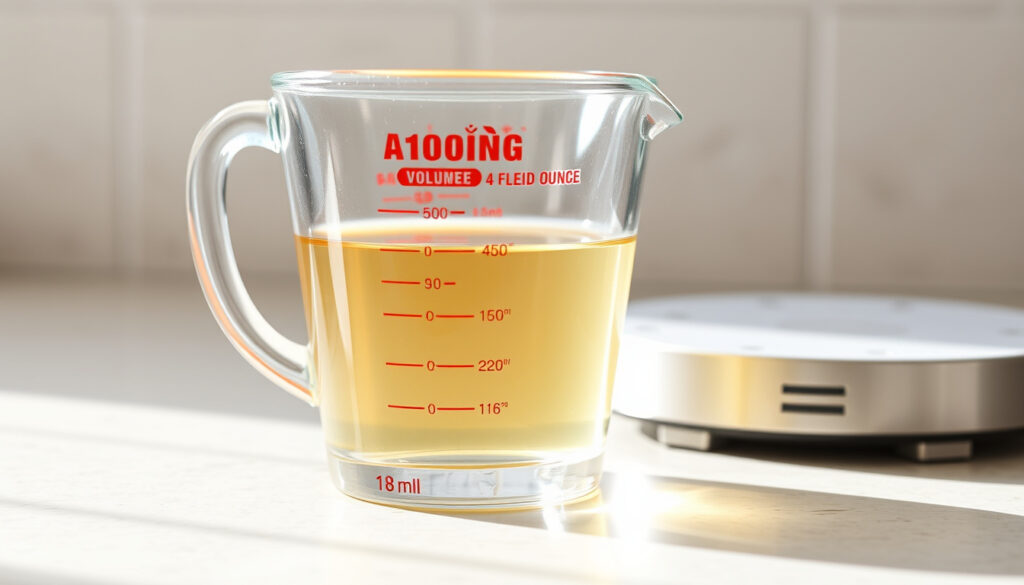
4 oz to ml: How Many Milliliters in 4 Ounces?
Anyone who has tried following a recipe from another country knows the moment of hesitation: “4 oz to ml—which ounce?” The confusion is real because the United States and the United Kingdom use different definitions of a fluid ounce. Knowing the exact conversion matters not only for baking but also for nursing and scientific work, where precision can directly affect outcomes. This article cuts through the ambiguity with exact numbers, practical contexts, and the reasoning behind common rounding.
4 US fl oz (exact): 118.294 ml · 4 UK fl oz (exact): 113.652 ml · 4 US fl oz in cups: 0.5 cup · 4 fl oz water weight: ≈118.3 g
Quick snapshot
- US: 118.294 ml (Inch Calculator conversion reference)
- UK: 113.652 ml (OVACEN conversion calculator)
- Common rounding: 120 ml (NCBI clinical reference)
- 4 US fl oz = 0.5 US cup (George Brown College nursing math guide)
- 4 UK fl oz = 0.56 UK cup (approx.) (George Brown College nursing math guide)
- Approx. 118.3 g (based on water density 1 g/mL)
- Varies with density for other liquids
- 100 ml = 3.38 fl oz (derived from Inch Calculator conversion factor)
- 120 ml = 4.06 fl oz (derived from same factor) (Inch Calculator conversion factor)
- 250 ml = 8.45 fl oz (derived from same factor) (Inch Calculator conversion factor)
Four key facts tell the story: the US and UK systems produce different milliliter values, and the gap matters in practical settings.
| Label | Value | Source |
|---|---|---|
| 4 US fl oz (exact) | 118.294 ml | Inch Calculator |
| 4 UK fl oz (exact) | 113.652 ml | OVACEN |
| 4 US fl oz in cups | 0.5 cup | George Brown College nursing math |
| 4 fl oz water weight | ≈118.3 g | Based on water density (1 g/mL) |
| 1 US fl oz | 29.5735 ml | Inch Calculator |
| 1 UK fl oz | 28.4131 ml | OVACEN |
| Nursing standard (1 fl oz) | 30 ml | George Brown College nursing math |
| Nursing standard (4 fl oz) | 120 ml | NCBI clinical reference |
The pattern: the US ounce is about 4% larger than the UK ounce, a difference that accumulates across multiple ounces.
How much is 4 oz in ml?
The exact answer for US fluid ounces
Using the US conversion factor of 29.5735 ml per fluid ounce (Inch Calculator conversion reference), 4 oz equals 118.294 ml. This is the value used in US cooking, nutrition labels, and scientific contexts.
The exact answer for UK fluid ounces
The UK imperial fluid ounce is smaller: 28.4131 ml per ounce (OVACEN conversion calculator). Multiplying gives 113.652 ml for 4 UK fluid ounces. British recipes and some Commonwealth countries use this standard.
Why some sources say 120 ml
In nursing and clinical settings, the ounce is often rounded to 30 ml for ease of calculation. The NCBI clinical reference explicitly lists 4 oz as 120 ml. This rounding is not mathematically exact, but it is widely accepted in healthcare because it simplifies dosing and reduces error risk.
Rounding to 120 ml is about 1.4% above the true US value. In a 4-oz medication dose, that margin might be acceptable; in a sensitive scientific formulation, it would not. Knowing which standard you are working under is essential.
The implication: the choice between rounding and precision depends entirely on the context—nurses trade accuracy for safety, while scientists cannot afford the drift.
Is 4 oz half a cup?
Fluid ounces vs dry ounces
A common point of confusion: fluid ounces measure volume, dry ounces measure weight. 4 fluid ounces of water fills half a cup, but 4 dry ounces (weight) of flour is about 0.9 cups. The George Brown College nursing math guide distinguishes between the two systems clearly.
How many fluid ounces in a cup
In US customary measurement, 1 cup equals 8 fluid ounces. Therefore, 4 fluid ounces is exactly 0.5 cup (same guide).
Using 4 oz in recipes
- US recipe calls for 4 oz milk: use 0.5 cup or 118.3 ml.
- UK recipe calls for 4 oz milk: use 0.56 UK cup or 113.7 ml.
- Dry ingredient measured by volume: not equivalent to fluid ounces.
The catch: if a recipe simply says “4 oz” without specifying fluid or dry, check the context—liquids are typically measured by volume.
The pattern: the cup equivalence holds only for US fluid ounces; UK fluid ounces yield a slightly different cup fraction, so always verify the system.
How many ounces is 250 ml?
Converting 250 ml to oz
250 ml divided by 29.5735 ml/oz equals 8.45 US fluid ounces. This is a common metric cup value used internationally. The OVACEN calculator shows that 8 US fluid ounces equals 236.588 ml, confirming that 250 ml is slightly more than 8 oz.
Converting 120 ml to oz
120 ml ÷ 29.5735 = 4.06 US fluid ounces. This is the value behind the nursing rounding: 4 oz is treated as 120 ml, but the precise conversion is 118.3 ml. The 1.7 ml difference is negligible for most clinical purposes.
Converting 100 ml to oz
100 ml ÷ 29.5735 = 3.38 US fluid ounces. This is a common serving size for wines and spirits; 100 ml is also used in some European recipes as a metric quarter-cup substitute.
The implication: metric-to-ounce conversions are straightforward once you know the factor, but the result depends on whether the target is US or UK ounces. The difference between the two systems grows larger as volume increases.
A 250 ml metric cup is only equivalent to 8.45 US fl oz, not 8. If a recipe calls for “1 cup” and you are using a metric cup, you will be off by about 14 ml without accounting for the system.
The catch: using the wrong cup definition can throw off baking ratios by more than 5%.
What is the difference between US and UK fluid ounces?
History of fluid ounce definitions
The US fluid ounce is based on the US gallon, which was derived from the English wine gallon. The UK fluid ounce is based on the imperial gallon, defined in 1824 as the volume of 10 pounds of water at 62°F. This historical divergence created a roughly 5% difference in volume.
Conversion factors: US vs UK
The two systems produce distinctly different milliliter values for the same ounce count.
| System | 1 fl oz (ml) | 4 fl oz (ml) | 8 fl oz (ml) |
|---|---|---|---|
| US customary | 29.5735 | 118.294 | 236.588 |
| UK imperial | 28.4131 | 113.652 | 227.304 |
All values sourced from Inch Calculator (US) and OVACEN (UK). The difference per ounce is about 1.16 ml—small but meaningful in bulk measurements.
The pattern: for a 4 oz difference, the US version holds about 4.6 ml more—enough to change the texture of a dough or the concentration of a formula.
When it matters (nursing, science, international recipes)
- Nursing: Standard rounding to 30 ml per ounce eliminates the distinction; 4 oz = 120 ml regardless of system (NCBI clinical reference).
- Science & lab work: The US customary ounce is used in US labs, but the metric system dominates; precise conversions are mandatory.
- International recipes: British cookbooks use UK fluid ounces; American cookbooks use US fluid ounces. Using the wrong conversion can throw off yields.
The upshot: knowing which system you are in is the first step to an accurate conversion; the second is choosing the right factor.
How to convert 4 oz to ml for nursing and cooking?
Conversion chart for common ounce values
This chart consolidates the three most common conversion standards side by side.
| Ounces | US ml (exact) | UK ml (exact) | Nursing ml (rounded) |
|---|---|---|---|
| 1 | 29.574 | 28.413 | 30 |
| 2 | 59.147 | 56.826 | 60 |
| 4 | 118.294 | 113.652 | 120 |
| 8 | 236.588 | 227.304 | 240 |
US and UK exact values from Inch Calculator and OVACEN; nursing values from George Brown College nursing math guide.
Using a calculator or formula
The formula is simple: multiply ounces by the appropriate factor.
- Determine which ounce system you are using: US, UK, or nursing.
- Select the correct conversion factor: 29.5735 for US, 28.4131 for UK, or 30 for nursing.
- Multiply the number of ounces by that factor.
- Round the result if necessary (nursing rounding is already applied, US/UK may be left as precise).
Online calculators such as Inch Calculator and OVACEN perform the math instantly. For manual conversion, always note which ounce system you are using.
Nursing: why 4 oz is often recorded as 120 ml
The NCBI clinical reference documents the standard: “4 oz × 30 = 120 mL or cc.” This simplification reduces calculation errors in fast-paced clinical environments. The same source notes that 1 teaspoon = 5 ml and 1 tablespoon = 15 ml, creating a consistent metric framework within nursing.
For home cooks, rounding to 120 ml is fine for most recipes, but if you are scaling precise formulations (e.g., infant formula, medication mixing), use the exact values above.
Nurses and clinicians rely on the 30 ml/oz shortcut because it is safe, memorizable, and consistent with other metric conversions. Home cooks can use it too, but for baking or chemistry, pull out the full decimal.
The pattern: the rounding is a deliberate trade-off—speed and safety over precision.
Confirmed facts
- 4 US fluid ounces = 118.294 ml (Inch Calculator)
- 4 UK fluid ounces = 113.652 ml (OVACEN)
What’s unclear
- Whether 4 US fl oz equals exactly 0.5 cup depends on using US customary cup measurement; UK cup is different.
- Nursing standard uses 1 fl oz = 30 ml, but this is a rounding convention, not an exact conversion.
- Water weight of 4 fl oz (118.3 g) assumes water at 4°C; at other temperatures, density changes.
- Whether 4 oz is exactly 120 ml in some informal contexts (nursing rounding is intentional, not an error)
- Whether a recipe using “oz” means US or UK fluid ounces when no origin is stated
“There are 118.294 milliliters in 4 fluid ounces.”
“1 ounces = 29.5735296875 milliliters.”
For home cooks and clinicians alike, the choice between US and UK fluid ounces is not arbitrary—it reflects centuries of separate measurement traditions. Using the correct conversion factor prevents errors that range from a slightly off cake to a miscalculated dose. The rule of thumb: when precision matters, check the ounce system first; when convenience matters, the nursing rounding to 30 ml per ounce works for most everyday situations.
If you need a step-by-step guide to avoid common mistakes, the 4 oz to ml conversion guide offers a thorough explanation.
Frequently asked questions
How many ml is 4 oz of water?
4 US fluid ounces of water is exactly 118.294 ml. Using the nursing rounding, it is often recorded as 120 ml. For UK fluid ounces, it is 113.652 ml.
Does 4 oz equal 1/2 cup?
Yes, 4 US fluid ounces equals exactly 0.5 US cup. This is because 1 US cup = 8 fluid ounces.
How many oz in 250 ml?
250 ml is approximately 8.45 US fluid ounces or 8.80 UK fluid ounces. The exact US value is 250 ÷ 29.5735 = 8.4535 oz.
What is 4 oz in ml UK?
4 UK fluid ounces equals exactly 113.652 ml. This is based on the imperial conversion factor of 1 UK fl oz = 28.4131 ml.
How to convert ounces to milliliters quickly?
Multiply by 29.5735 for US ounces, by 28.4131 for UK ounces, or by 30 for nursing shorthand. Online calculators like Inch Calculator and OVACEN do it instantly.
Is 4 fl oz the same as 4 oz weight?
No. Fluid ounces measure volume; ounces (avoirdupois) measure weight. 4 fluid ounces of water weighs about 4.2 oz by weight because water has a density of about 1 g/ml.
Why do some recipes use 120 ml for 4 oz?
Because they rely on the nursing or commercial rounding convention that 1 fl oz = 30 ml. This is practical for quick conversions but is not mathematically exact.
More related posts
 Chris Pratt: Children, Divorce, Net Worth, and Personal Struggles
 John Tory: Wife, Illness & His Full Political Career
 Wealthsimple Visa Infinite Privilege: Benefits, Guide, and Review
 Mark Stone: Hockey Star, Journalist, Opera Singer & Bassist
 Luc Besson: French Filmmaker Behind The Fifth Element
 Insurance Council of BC – Regulation and Compliance Guide
 Vic Michaelis: Age, Gender Identity, Marriage & More
 Jeff Bridges Lymphoma: His Battle, Recovery, and Life Now